Every conventional web search query leaks a high-entropy fingerprint before a single document is ranked. When a developer or researcher submits a query directly to a commercial search portal, the browser transmits the residential or corporate IPv4/IPv6 address, TLS JA3/JA4 cipher order, Sec-Ch-Ua client hints, persistent session cookies, and cross-origin Referer headers. Over a single afternoon of debugging stack traces or investigating vendor APIs, those signals assemble a deterministic behavioral graph tied to a single workstation.
To eliminate query-level identity correlation without sacrificing retrieval precision, we engineered the NetSearch Anonymous Search Engine Proxy (also accessible at /proxy and via JSON API at /api/netsearch/search). Rather than forcing users to route all workstation traffic through high-latency overlay networks, the NetSearch proxy acts as a stateless, zero-log application-layer relay that terminates client HTTP headers in volatile memory, executes federated retrieval across our local Okapi BM25 corpus and upstream public knowledge indexes using a generic server identity, strips tracking parameters from outbound destination links, and renders a zero-telemetry SERP.
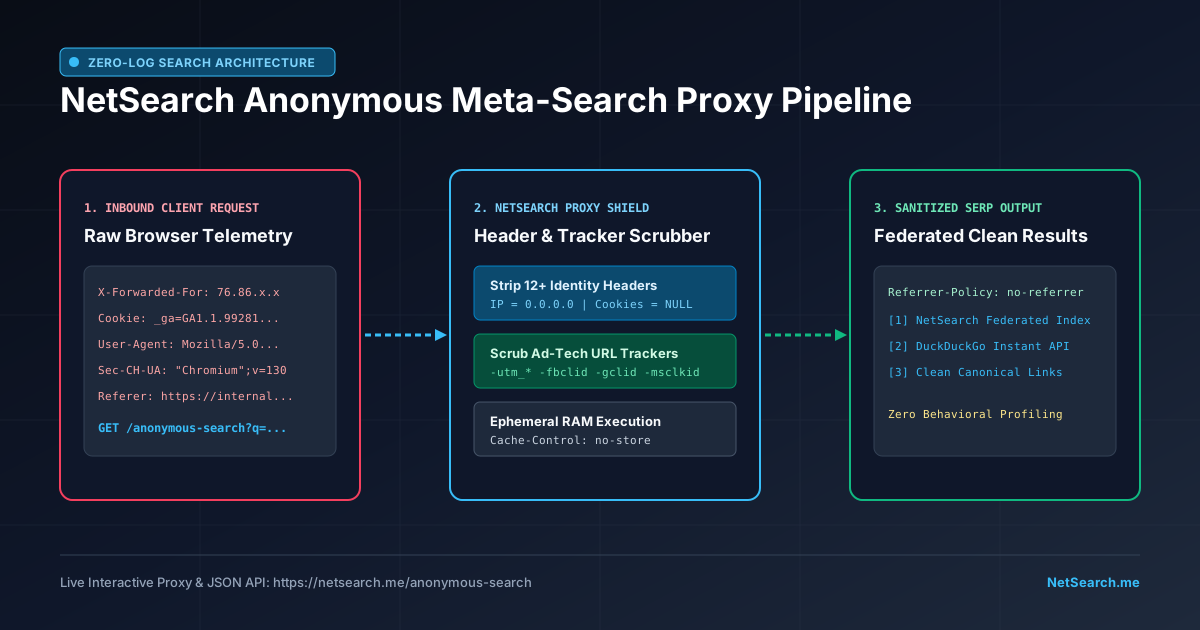
1. Threat Model: How Direct Search Queries Deanonymize Technical Teams
Even when an engineer enables browser "Incognito" mode or clears local storage, three structural telemetry vectors remain active during direct search engine queries:
- Network & Transport Correlation: Search providers log the tuple of
(Client IP, Timestamp, Raw Query String, TLS Fingerprint). When multiple engineers on the same corporate NAT gateway query proprietary package names, CVE identifiers, or acquisition targets, the search provider correlates those queries to the organization's autonomous system number (ASN) and subnet. - Client Hint & Header Entropy: Modern Chromium browsers send granular headers including
Sec-Ch-Ua-Platform-Version,Sec-Ch-Ua-Arch,Accept-Language, andX-Client-Data. Combined with screen viewport dimensions reported by client-side JavaScript beacons, these headers uniquely identify individual machines behind a shared NAT. - Outbound Click-Wrap & Redirect Tracking: Standard search engine result pages rewrite destination anchor tags into intermediary redirect URLs or append attribution tokens (
utm_source,gclid,fbclid,msclkid,_ga). Clicking a result transmits both the search referrer and the tracking token to the destination host.
2. Stage 1: Ingress Header Scrubbing & Ephemeral Memory Execution
When a request reaches https://netsearch.me/anonymous-search, the proxy middleware immediately constructs an isolated upstream execution context. None of the incoming client identification headers are forwarded to external index endpoints or written to application query logs.
| Ingress Header / Vector | Default Browser Behavior | NetSearch Proxy Sanitization Action |
|---|---|---|
X-Forwarded-For / Client Socket IP |
Exposes residential or corporate subnet to upstream search index | Stripped. Upstream requests originate solely from the NetSearch relay socket. |
User-Agent & Sec-Ch-Ua* |
Leaks OS kernel build, CPU architecture, and exact browser minor version | Replaced with static uniform identifier NetSearch-Anonymous-Proxy/2.0 (+https://netsearch.me/anonymous-search). |
Cookie & Set-Cookie |
Persists cross-session user IDs and behavioral cohort buckets | Dropped in both directions; zero session cookies are read or emitted on proxy routes. |
Referer Header |
Transmits full search query URL to destination site upon click | Enforces HTTP response header Referrer-Policy: no-referrer and link attribute rel="noreferrer noopener". |
| Browser Disk Cache | Caches query HTML and search history locally on workstation disk | Emits strict Cache-Control: no-store, max-age=0 and X-Robots-Tag: noindex, nofollow on active query responses. |
Every response returned by both the interactive HTML view and the programmatic JSON endpoint includes a live privacyAudit receipt listing the exact headers stripped on that request, allowing security teams to verify header hygiene deterministically.
3. Stage 2: Federated Server-Side Retrieval (Local BM25 + Public Knowledge APIs)
A privacy proxy is only useful if its underlying information retrieval engine surfaces authoritative technical documents rapidly. Rather than relying on a single brittle upstream scraper, the NetSearch proxy executes a parallel fan-out across two complementary retrieval tiers:
Tier A: Local Multi-Domain Inverted Index with Okapi BM25 Scoring
First, the proxy tokenizes the query (stripping stop-words while preserving technical tokens such as bm25, lsm, raft, and simhash) and evaluates it against our 101-Node Federated Technical Corpus. Each candidate document is scored using our in-memory Okapi BM25 ranking pipeline with saturation constant k1 = 1.5 and document length normalization b = 0.75, plus field-level boosts for exact phrase matches in post_title (4.5x), post_name slug tokens (2.5x), and post_category (2.0x). Because this tier executes entirely in local process RAM, local corpus lookups complete in under 5 milliseconds with zero external network I/O.
Tier B: Server-Side Anonymized Upstream Federation
Simultaneously, when the caller selects the federated or external source scope, the server dispatches asynchronous HTTPS requests with a strict 2,800ms abort timeout to open knowledge APIs—specifically the MediaWiki OpenSearch specification and DuckDuckGo Instant Answer JSON endpoints. Because the NetSearch server originates these TLS handshakes using a normalized Accept-Language: en-US,en;q=0.5 header and zero cookies, the upstream provider sees only an aggregate server request from our data center rather than the individual researcher.
// Sanitize outbound URLs by stripping marketing & click-ID trackers
const TRACKING_PARAMS = new Set([
  'utm_source', 'utm_medium', 'utm_campaign', 'utm_term', 'utm_content',
  'gclid', 'fbclid', 'msclkid', 'twclid', 'dclid', 'mc_cid', 'mc_eid',
  '_ga', '_gl', 'ref', 'ref_src', 'spm', 'igshid', 'yclid'
]);

export function stripUrlTrackingParams(rawUrl: string): string {
  const parsed = new URL(rawUrl);
  for (const key of Array.from(parsed.searchParams.keys())) {
    if (TRACKING_PARAMS.has(key.toLowerCase()) || key.toLowerCase().startsWith('utm_')) {
      parsed.searchParams.delete(key);
    }
  }
  return parsed.toString();
}
4. Stage 3: URL Sanitization & Zero-Telemetry SERP Synthesis
Before any federated result is rendered into the HTML response or serialized into JSON, its destination URL passes through stripUrlTrackingParams(). This deterministic filter removes 19 classes of marketing attribution parameters and click identifiers while preserving functional query parameters required for documentation pagination or code search.
In addition, every result card in the Anonymous Search UI provides two distinct navigation options:
- Direct Scrubbed Link: Opens the canonical destination URL directly with
rel="noreferrer noopener"and browser-enforcedReferrer-Policy: no-referrer, ensuring the destination site never learns that the visitor arrived from a search query. - Anonymized Preview Relay: Routes the click back through
/anonymous-search?q=domain/slugso engineers can inspect surrounding corpus metadata and related indexed articles without leaving the zero-log proxy boundary.
5. Programmatic JSON API for Autonomous Research Agents
In addition to interactive browser usage, autonomous coding agents and CI research pipelines can query the proxy directly via GET or POST at https://netsearch.me/api/netsearch/search:
curl -s "https://netsearch.me/api/netsearch/search?q=distributed+raft+consensus&source=federated&limit=10" | jq '{query, totalResults, elapsedMs, strippedHeaders: .privacyAudit.strippedClientHeaders}'By pairing distributed inverted-index architecture with strict ingress header termination, the NetSearch Anonymous Search Proxy gives engineers and automated agents fast, reproducible information retrieval without surrendering network identity.